

Extending Girls’ Leadership in Robotics: Strategies for Sites
By Steph Morgado
Building sustainable, equity-driven STEM opportunities for girls is both an aspiration and an urgent need. The Girls in Robotics Leadership (GIRL/GIRL+) model, developed through the partnership between the Solano County Office of Education and the UC Davis C-STEM Center, offers a powerful, research-informed approach for helping girls build confidence, technical skills, and leadership pathways. While our workshop at the conference in October, “In and Out of STEM Classrooms”, explored the foundations of this work, as well as sharing highlights from Summer 2025, many educators asked for practical ways to bring elements of GIRL camps into their own contexts. The good news? You can begin with what you already have.
One of the biggest takeaways from GIRL camp is the power of representation and belonging. Camp data speaks for itself:
- 77% of participants reported increased confidence in coding,
- 93% believed “people like me can do well learning technology,”
- 90% said they would take another programming class.
These outcomes are grounded not in expensive materials but in intentional culture-building by celebrating student voice, centering collaboration, and designing activities where creativity and identity matter as much as the code. Educators who want to adopt similar practices can start with three simple, high-impact strategies:
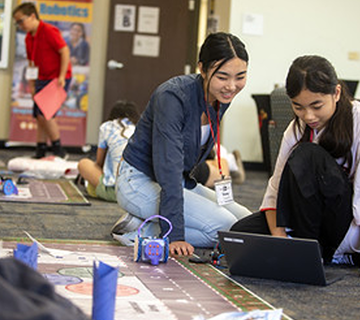
1. Coding coach (and high school student leader) supporting a middle school student through a coding mat challenge.
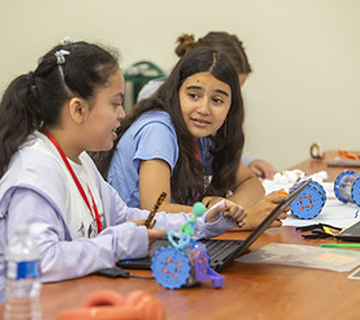
3. A high school team collaborating during a coding lesson.
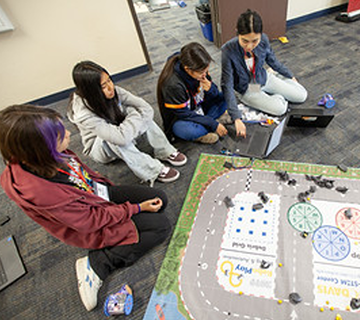
2. Coding coach (and high school student leader) and a high school team working on their final coding project, programming their robot to explore the asteroid belt to collect samples.
1. Create micro-communities of practice
You don't need a full camp to cultivate belonging. Try forming small, interest-based cohorts during lunch, after school, or within an existing class. Structure sessions around exploration, icebreakers, hands-on tinkering, peer-led demos, and student storytelling. GIRL camps show that these community-building elements are just as transformative as robotics itself.
2. Build STEM identity through leadership
You can start small to begin building powerful student pathways, from first-time campers to volunteer leaders, club coaches, community presenters, and STEM professionals. Even one leadership moment can flip a student’s perception from “I’m learning STEM” to “I belong in STEM.” Schools, after-school programs, districts, or county offices of education can replicate this by creating leadership touchpoints:
- Invite student leaders to co-plan an activity for younger grades
- Offer volunteer roles in STEM events to help recruit and build leadership
- Create teen-led coding “help desks”
3. Integrate accessible coding tools
Platforms, like RoboBlocky, offer drag-and-drop coding, math integration, and universal design features that support a wide range of learners. But the tool itself is secondary; the impact comes from meaningful challenges, collaborative problem-solving, and celebrating student creations publicly, as GIRL camps do through culminating events and showcases.
Ultimately, the GIRL/GIRL+ framework succeeds because it blends identity, community, and authentic STEM experiences. Whether you start with a single activity, a classroom mini-unit, or a districtwide initiative, the core principles remain the same: start small, stay student-centered, and celebrate every young person who takes a brave step into STEM.
For more information, please contact:
Steph Morgado
Program Manager, STEAM and Robotics
Solano County Office of Education
SMorgado@SolanoCOE.net
Tags
Save | Print | Email Article

Related Articles


From time to time CASE receives contributions from guest contributors. The opinions and views expressed by these contributors are not necessarily those of CASE. By publishing these articles CASE does not make any endorsements or statements of support of the author or their contribution, either explicit or implicit. All links to outside sources are subject to CASE’s Disclaimer Policy.