

How Can We Move the Needle? Promoting Environmentally Sustainable Behavior in Students
By Piper Hamill
We hope everyone who attended our session “Hormone Imposters – Impacts on Rhino Reproduction” at the 2025 CASE Confernece had a great time! We always enjoy engaging with educators each year. This time, we explored how San Diego Zoo Wildlife Alliance's Conservation Science team is investigating endocrine disruptors to improve animal health and breeding.
As part of the Community Engagement team, we connect textbook concepts to real-world scenarios through our field trips and professional development. Interested in incorporating our conservation science labs into your classroom? Consider checking out our Teacher Workshops in Conservation Science, a free PD held each summer for informal and formal educators who work with grades 6–12.
By connecting people to our research, we hope to increase advocacy and stewardship for wildlife. That is why each of our labs has an associated conservation behavior to empower students to action. But how can we as educators best situate ourselves to accomplish this?
First, it is essential to recognize that awareness campaigns alone often fail to bring about lasting behavior change. This can be a hard pill to swallow as an environmental educator. So how can we be more effective? Recently, our team has begun using elements of Community-Based Social Marketing to identify the behaviors we should target and develop more effective strategies. If you are interested in engaging students in conservation more effectively, there are four key criteria to consider in behavior selection:
- Impact: What behavior is the most impactful for our desired ecological outcome? Do we save more water with efficient dishwashers or washing machines?
- Applicability: Who does this apply to? Keeping cats indoors is important for native biodiversity, but this is only relevant to a small section of students.
- Potential reach: How many students already do this? About 75% of our students use a reusable water bottle. Great! Now we should pivot to where there is more potential reach.
- Probability: If they haven’t adopted the behavior, how likely is it that they will? About 60% of our students said they are very unlikely to ride the bus. This may be due to extensive barriers like access, and we are unlikely to be effective here. Instead, we should focus on behaviors where we are more likely to move the needle.
These can all be determined through classroom observations, research, or surveys. Don’t worry, surveys can be simple! Figure 1 shows a survey question assessing a behavior's probability, reach, and applicability all in one.
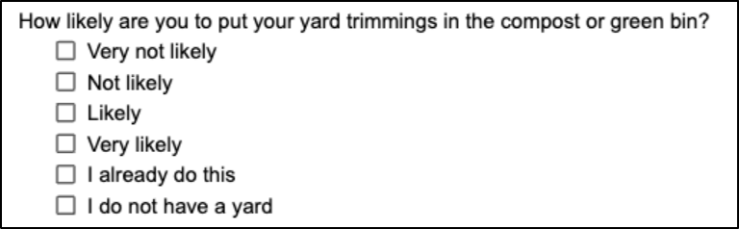
Figure 1: Example Survey Question for Composting Yard Trimmings. Students that answer “I do not have a yard” are the percent of the audience to which the behavior is not applicable. Students that answer “I already do this” are the percent adopted. The remaining answers are used to calculate the probability score. Here, I used a 1-4 scale.
Once you decide what behaviors to target, it is important to understand the existing barriers and motivators to action. This can be as simple as just asking your students, and it will be essential for informing your strategies. No access to safe bike lanes? Start a letter-writing campaign! Not sure what is compostable? Education and awareness can be effective here. Forgetting reusable bags? Try pledges and reminders. Just low motivation? Look into contests and incentives. However you choose to move forward, it is important to follow best practices for messaging, use social norms carefully, and consider how to move beyond individual action to collective action when possible.
There is so much more to learn, but hopefully you are inspired to start tailoring conservation messaging and strategies to your students. When we consider our students’ needs, we are much more likely to move them from awareness to action.
Tags
Save | Print | Email Article

Related Articles


From time to time CASE receives contributions from guest contributors. The opinions and views expressed by these contributors are not necessarily those of CASE. By publishing these articles CASE does not make any endorsements or statements of support of the author or their contribution, either explicit or implicit. All links to outside sources are subject to CASE’s Disclaimer Policy.