

Cultivating Resilience and Real Science in the Classroom with the FRYS Network
By Peggy Harte and Rebecca VanArnam
On a foggy morning in California’s Central Valley, a group of high school students gather around a classroom fish tank. Inside, salmon are swimming– some moving quickly, others resting at the bottom, gills pulsing, but bodies still. “That one has a curled spine,” one student says. Another records the data. Right next to the tank is another small group checking water quality (ammonia, pH, nitrite, and nitrate). This is not a simulation. These students are researchers.
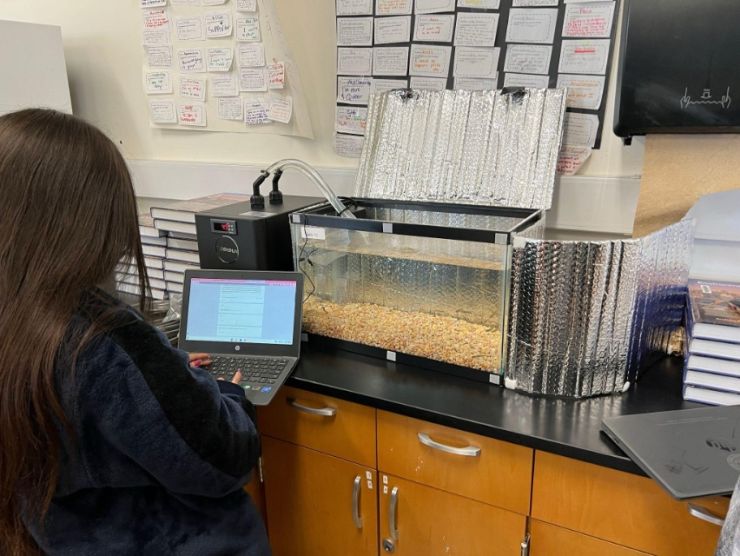
characteristics and behavior using scientific observation
protocols. These daily observations help students build
scientific skills while contributing to a broader effort to
understand salmon development. (Photo Credit: Peggy Harte)
This is just one example of the start of the day for one of 45 adventurous teachers and more than 3,500 curious students who have stepped into the role of researchers. The Fish and Rivers Youth Scientists Network (FRYS Network), co-led by the UC Davis Center for Community and Citizen Science at the School of Education alongside watershed sciences partners, bridges rigorous environmental science with classroom inquiry, inviting students to contribute meaningful data to an urgent conservation challenge while building connections to their local ecosystems, professional scientists, and future STEM pathways.
At the heart of the program, middle and high school students investigate Thiamine Deficiency Complex (TDC), caused by a lack of vitamin B1. TDC was first documented in California’s Chinook salmon in 2020. TDC causes juvenile salmon to swim erratically and suffer high mortality rates. Rather than observing from afar, students receive salmon eggs and raise fish in classroom tanks, systematically recording behavior, survival, and environmental conditions using observation protocols co-developed with researchers from the UC Davis Center for Watershed Sciences, NOAA Fisheries, and the California Department of Fish and Wildlife.
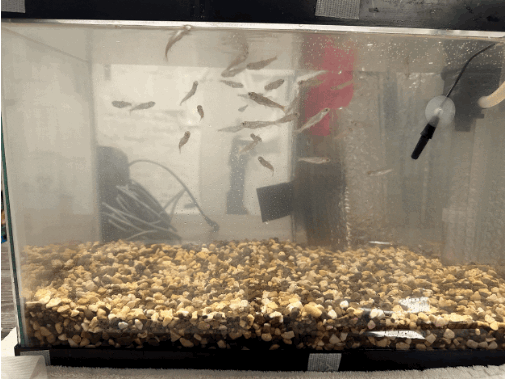
Rivers Youth Scientists (FRYS) Network. “Fry” are young
salmon in an early life stage, when careful monitoring can
reveal important indicators of health and survival.
(Photo Credit: Lisa Colombani)
This is real science. Each student observation joins a larger dataset used by researchers to understand how TDC may influence juvenile survival, critical knowledge for strengthening salmon resilience in a changing climate. Students analyze their own data alongside agency datasets, developing data literacy skills grounded in authentic context. The learning environment is intentionally designed so all students, especially multilingual learners, can participate meaningfully. Teachers use Universal Design for Learning (UDL) principles: iterative modeling, use of embedded videos, multi level readings, dialogue and data protocols, sentence frames, and structured classroom discussions to ensure all students can participate meaningfully. Students demonstrate understanding through hands-on monitoring, digital data analysis, field experiences, and oral presentations. Lessons connect salmon conservation to students’ lived experiences, including Indigenous stewardship traditions and local agricultural and fishing communities, reinforcing that environmental resilience is both scientific and cultural work.
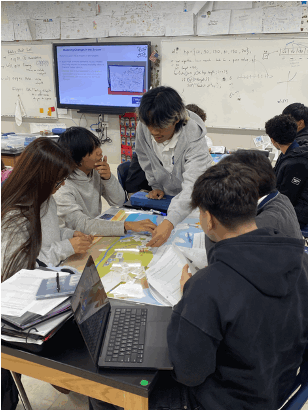
activity, identifying connections between environmental
conditions, salmon health, and broader ecological processes.
This systems modeling helps students understand how
local observations relate to global environmental change.
(Photo Credit: Michael Wee)
Beyond technical skills, the program cultivates purpose. Students interact directly with scientists through classroom visits, Q&A sessions, and field trips, one student reflects, “our data is needed to help salmon.” At that moment, the line between “scientist” and “student” blurs. Now in its fifth year, the FRYS Network demonstrates that science education can be inclusive, culturally relevant, and action-oriented. When students recognize that their data informs real conservation decisions, engagement deepens and agency grows. In these classrooms,people, planet, and purpose intersect , building resilience not only for salmon, but also for the communities who care about their future.
To learn more, please visit the UC Davis Center for Community and Citizen Science - FRYS Network Program Page.
Tags
Save | Print | Email Article

Related Articles


From time to time CASE receives contributions from guest contributors. The opinions and views expressed by these contributors are not necessarily those of CASE. By publishing these articles CASE does not make any endorsements or statements of support of the author or their contribution, either explicit or implicit. All links to outside sources are subject to CASE’s Disclaimer Policy.