

Teaching Towards a Sustainable Future
Authors: Maycee Ballew, Dr. Julie Bianchini, John Galisky, Paul Huang, Dr. Karin Lohwasser, Brendan Ly, Jenna Pham
Teaching Towards a Sustainable Future: Visualizing Climate Change and Sustainability Across Disciplines
California’s new Assembly Bill 285 asks all teachers of science, from 1st to 12th grade, to teach “the causes and effects of climate change and methods to mitigate and adapt to climate change.” Given the scale and complexity of our climate crisis, this mandate can feel overwhelming to a single teacher. However, if teachers in a school can find ways to collaborate and allocate different causes of and solutions to climate change to each grade level, students will gain a more complete understanding of how to move towards a sustainable future over time.
In our Solutions Mapping workshop (click for resources), we introduced participants to a way to visualize the complexity and scale of the climate crisis, connect causes to possible solutions, and determine what and how to teach climate change at different grade levels. In groups, participants organized cards that name causes including historical events that led to climate change, their effects, and possible solutions. We encouraged participants to include additional ideas on blank cards. When their map was complete, participants narrowed down the areas they could address in their own teaching, knowing that their colleagues could take on other parts. For example, a high school science team discussed which causes and solutions of climate change could be taught in biology and which ones, in physics and chemistry.
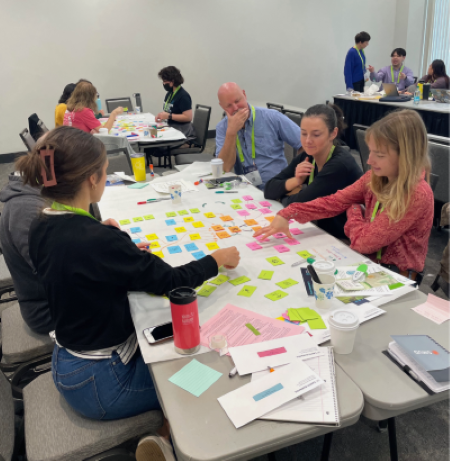
Workshop participants engaged in mapping causes, effects, and possible solutions for a changing climate.

A climate solution map created by one of the groups participating in the Solution Mapping workshop. Yellow and orange cards depict mechanisms of and reasons for climate change, pink and blue cards depict consequences of and historical events that exacerba
The presenting team of four first-year science teachers and their former instructors hope that this activity can find its way into schools to not only engage science teachers but teachers of all subjects. A simplified version of this activity can also be utilized with students to show them how their learning connects to a global problem and how a multitude of solutions is necessary for a sustainable future. Climate change is a pressing societal problem that requires all teachers and their students to take informed action.
Authors
- Maycee Ballew: Biology teacher, Dos Pueblos High School, Santa Barbara Unified School District
- Dr. Julie Bianchini: Professor and science methods instructor, University of California, Santa Barbara
- John Galisky: Teacher education and science methods instructor, University of California, Santa Barbara
- Paul Huang: Biology teacher, Sheldon High School, Elk Grove Unified School District
- Dr. Karin Lohwasser: Associate teaching professor and science methods instructor, University of California, Santa Barbara
- Brendan Ly: Chemistry teacher, Eleanor Roosevelt High School in Eastvale, Corona-Norco Unified School District
- Jenna Pham: Biology teacher, Aspire Alexander Twilight Secondary Academy, Aspire Public Schools
Tags
Save | Print | Email Article

Related Articles


From time to time CASE receives contributions from guest contributors. The opinions and views expressed by these contributors are not necessarily those of CASE. By publishing these articles CASE does not make any endorsements or statements of support of the author or their contribution, either explicit or implicit. All links to outside sources are subject to CASE’s Disclaimer Policy.