

Growing Solutionaries: How Seeds to Solutions Builds Climate Confidence in Students
By Chris Brown & Holly Steele
Any educator who teaches environmental literacy or climate change has both an opportunity and a responsibility: to address the eco-anxiety many students carry. If environmental literacy is to be meaningful, it must cultivate agency alongside awareness.
A 2021 study published in The Lancet (Hickman et al.) found that 59% of young people surveyed were very or extremely worried about climate change, and many reported feelings of powerlessness about their future. The American Psychological Association has similarly identified eco-anxiety as a growing psychological response among youth.

Our standards do not call us to teach despair. Next Generation Science Standards ask students to analyze and interpret data, examine cause and effect, model systems and system interactions, engage in argument from evidence, and design solutions to complex problems. California’s Environmental Principles and Concepts affirm that human communities and natural systems are interconnected and that stewardship requires informed decision-making. Embedded within these frameworks is a solution-oriented mindset grounded in critical thinking, systems awareness, and responsible action that empowers students to become solutionaries.
Teaching through a solutions-oriented lens does not minimize environmental challenges. Rather, it frames them as problems worthy of thoughtful solutions. And it gives students the antidote to eco-anxiety: the skills, confidence, and hope that they can affect their communities.
Educators looking for supplemental materials grounded in solutions, agency, and hope should consider Seeds to Solutions. Funded by the California Department of Education and developed in partnership by the San Mateo County Office of Education and nonprofit Ten Strands, Seeds to Solutions includes 13 K-12 units focused on California-specific environmental phenomena. This free, open set of instructional resources equips educators with age-appropriate climate education and environmental justice lessons.
The heart of Seeds to Solutions is how each unit builds coherently to culminating engagements, where students apply their learning in meaningful ways. This approach clearly supports positive science identity development, in which learners can see themselves as people who know about, use, and sometimes contribute to science, which is the home discipline of the units. This contributes to a positive classroom community and a schoolwide culture that positions young people as capable citizens, community members, and solutionaries who can and will contribute to the well-being of their community.
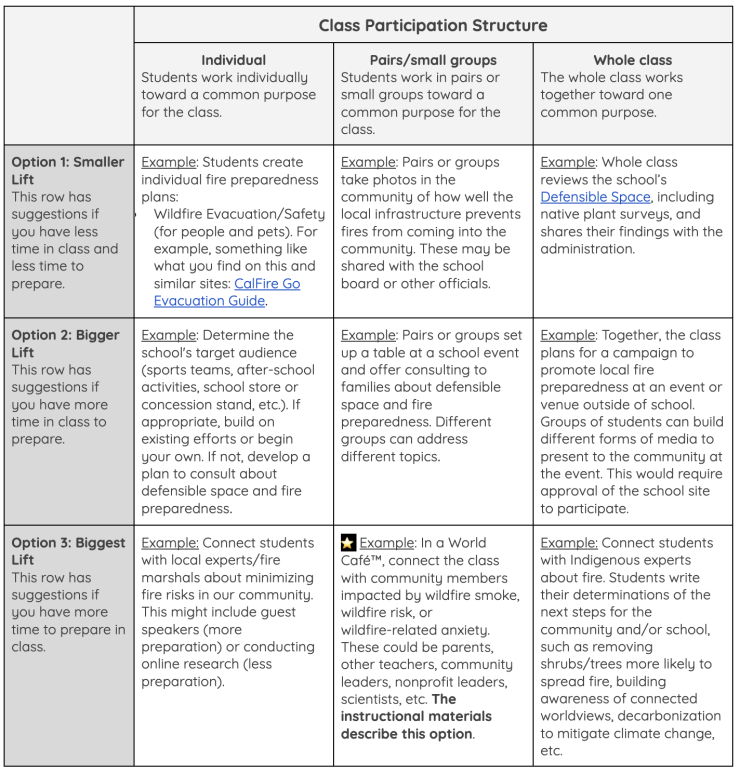
Seeds to Solutions materials offer educators suggestions for structuring a culminating engagement for students. Presented options vary based on the educator's preferred groupings (e.g., individual, pairs/small groups, or whole class) and the class's overall capacity (e.g., small lift, bigger lift, or biggest lift).
As part of the fifth-grade unit exploring how Californians can use fire responsibly to prevent destructive wildfires, students might work in small groups to set up a table at a school event and offer consulting to families about defensible space and fire preparedness. Alternatively, students might work together as a whole class to review the school’s defensible space and share their findings with the school’s administration.
CC BY-NC-SA 4.0, access within 5th-grade unit)
While Seeds to Solutions offers suggestions for culminating engagement activities, these options are not exhaustive, and it’s important to be responsive to student interests. For example, eighth-grade students in Roxana Flores’ class at Woodville Union School in Tulare County paired their interest in documentary filmmaking with her recent implementation of the land subsidence unit. Students are currently interviewing experts, including those involved in developing the unit, to showcase solutions to water contamination in their local community.
By intentionally elevating case studies of progress and embedding authentic opportunities for solution design, we can guide students toward developing the skills, confidence, and civic identity needed to participate in both stability and change — rather than retreat from it.
If you’d like to learn more about how Seeds to Solutions can support your students in hopeful learning about climate science, please visit seedstosolutions.org or email Holly Steele at hsteele@tenstrands.org. Free, drop-in office hours are also available from 4:00 to 5:00 pm on the 2nd and 4th Wednesdays of each month.
Citations
Climate anxiety in children and young people and their beliefs about government responses to climate change: a global survey
Hickman, Caroline et al.
The Lancet Planetary Health, Volume 5, Issue 12, e863 - e873
American Psychological Association. (2017, March 17). Climate Change’s Toll On Mental Health. American Psychological Association. https://www.apa.org/news/press/releases/2017/03/climate-mental-health
Tags
Save | Print | Email Article

Related Articles


From time to time CASE receives contributions from guest contributors. The opinions and views expressed by these contributors are not necessarily those of CASE. By publishing these articles CASE does not make any endorsements or statements of support of the author or their contribution, either explicit or implicit. All links to outside sources are subject to CASE’s Disclaimer Policy.