

Hope in Action: How Agency First Classrooms Change Everything
By Christina Miramontes
This year, something unexpected happened in my science classrooms: students didn’t want the units to end. Their reaction signaled something deeper than engagement; they experienced learning as meaningful, self-driven, and hopeful. This article extends my 2025 CASE Conference workshop by showing how agency-first practices and AI-supported co-design, grounded in voice, choice, co-planning, and systematic measurement, create that shift.
Hope Comes First: Measuring Mindset to Transform Learning
At the foundation of this work is the Hope Scale, a six-question assessment measuring students’ agency and pathways of thinking. In this framework, hope = agency + pathways, a mindset that predicts persistence and problem-solving. Quarterly check-ins help educators see students’ mental health and growth over time.
Co-Designing Learning With Students and AI
The core flow is simple: Voice → Choice → Curiosity → Ownership.
Each unit begins with students generating their own questions. Tools like Padlet or Thin Slides ensure every student contributes. Their questions then merge with NGSS-aligned content, with AI tools helping streamline planning.
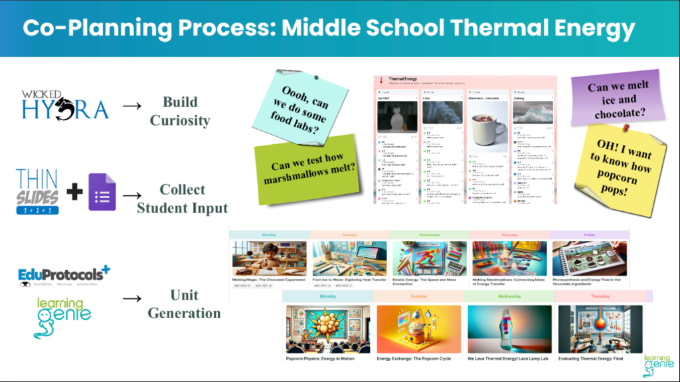
This process aligns naturally with NGSS practices, especially Asking Questions, Defining Problems, and Planning and Carrying Out Investigations. During our Thermal Energy unit, students’ questions about melting chocolate and making popcorn became the foundation for food science investigations. As they designed tests and explored their ideas, they engaged in authentic scientific practice and connected to Crosscutting Concepts by examining cause-and-effect and modeling energy flow. Their curiosity took over, and lab ideas poured out. For the final showcase, students modeled a favorite food lab to demonstrate kinetic energy transfer. They were thrilled that this was the assessment and disappointed that the unit was ending.
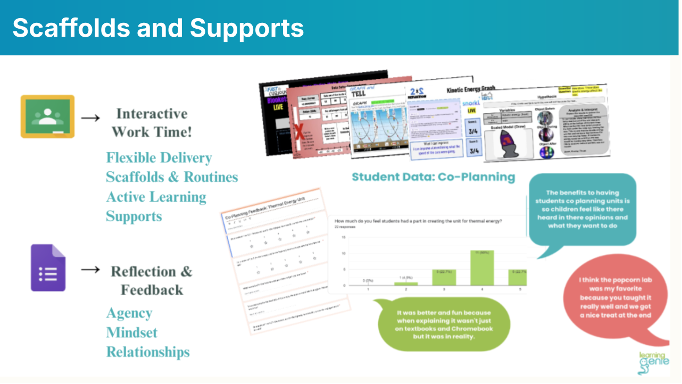
This simple structure reinforces that student input drives instructional decisions. It builds trust and transparency while supporting teachers facing limited planning time and high differentiation needs.
The Agency Audit
To keep the ecosystem responsive, students complete a brief weekly reflection:
- Did you have a voice in your learning?
- Did you have meaningful choices?
- Did today’s work make you curious?
Why This Matters: Evidence of Impact
Agency-based learning is especially powerful for students who need extra support. Predictable routines, short goals, simple templates, and positive language give them the safety to take risks. As confidence grows, students move from “I can’t do this” to “I didn’t know I could do that, what’s next?” Daily work completion now averages about 98 percent.
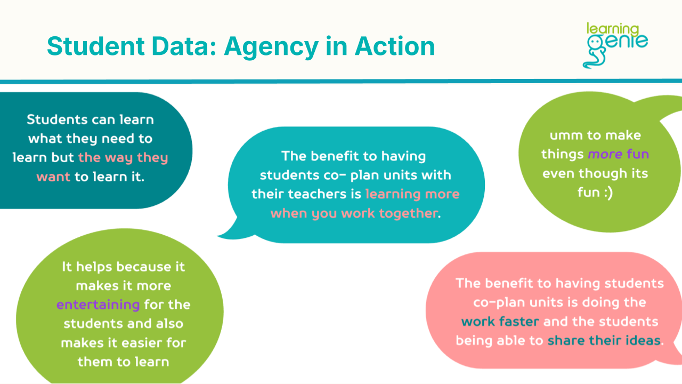
Co-planning amplifies these gains. After helping design the unit, 87 percent of students said they were “excited to see what happens next,” reflected in a 12 percent increase in daily work completion and fewer absences on lab days. Even students with low hope scores showed greater persistence and curiosity. These results align with hope theory; when students help shape learning, they invest in the investigations ahead.
An agency-first system does more than boost engagement; it reshapes how students see themselves. Co-designing learning, supported by AI tools, prepares them for futures where curiosity, adaptability, and agency matter most. Our greatest gift is not answers, but the belief that students can create new pathways and purposeful futures for themselves.
Tags
Save | Print | Email Article

Related Articles


From time to time CASE receives contributions from guest contributors. The opinions and views expressed by these contributors are not necessarily those of CASE. By publishing these articles CASE does not make any endorsements or statements of support of the author or their contribution, either explicit or implicit. All links to outside sources are subject to CASE’s Disclaimer Policy.