

The JEDI Awakens: Designing for Justice in Science Classrooms
By Nishat Alikhan, Jessica Bibbs-Fox, Bree Barnett Dreyfuss, Stephanie Chiang, Kristin Majda, Tara Sikorski with assistance from Claude.ai on behalf of the CASE DEI Committee
Picture this: Your students are analyzing mountain lion sightings in Los Angeles using iNaturalist data. But instead of simply mapping wildlife corridors, they're grappling with a deeper question—whose voices matter when we design solutions for urban wildlife? Suddenly, the engineering design process becomes more than a protocol; it becomes a conversation about justice.
This is what happens when we center Justice, Equity, Diversity, and Inclusion (JEDI) principles into our NGSS-aligned curriculum. And trust us, it changes everything.
When Wildlife Encounters Intersect with Justice
At this year's CASE conference, our DEI Committee presented "The JEDI Awakens," a session exploring how Liberatory Design can transform traditional engineering design challenges by centering the design process around equity. This approach asks designers to examine systems for inequities and uplift the voices and perspectives of everyone impacted by the designs.
We used the increasing incidences of urban wildlife encounters as our phenomenon—a perfect storm of ecological disruption, urban planning, and social justice that California students can see right outside their classroom windows.
The hook was simple: headlines about coyotes on softball fields, mountain lions wandering into people’s homes, and bears in suburban neighborhoods. Participants immediately noticed patterns in the data. But then we asked them to wonder “Why are these encounters happening?” and more importantly, “Who gets to decide what action is taken?”.
That's where the JEDI adventure—and the discomfort—began.
Beyond "Design a Solution"
We centered the urban wildlife lesson used in the professional learning session on the CA NGSS performance expectations of:
MS-LS2-1: Analyze and interpret data to provide evidence for the effects of resource availability on organisms and populations of organisms in an ecosystem.
HS-LS2-7: Design, evaluate, and refine a solution for reducing the impacts of human activities on the environment and biodiversity.
Traditionally, the practice of engineering design asks students to identify problems and create solutions. Liberatory Design asks the learner to question whose problem they're solving and who designed the system in the first place. In this case, participants were challenged to first define the problem from the perspectives of the wildlife and then from the perspectives of humans.
Before engaging in the design thinking, session participants were asked to choose a community member role to embody during the design process: an Urban Ecologist, an Indigenous Tribal Environmental Steward, a resident from a low-income community, an HOA representative, or a City Council member. Each perspective revealed different priorities, different definitions of success, and different concerns, all of which were communicated to participants on the provided Community Member Role Cards.
For example, the Indigenous Steward might prioritize traditional ecological knowledge and spiritual relationships with wildlife. The low-income resident might worry about safety and lack of city services in their neighborhood. The HOA representative might focus on property values. Suddenly, a potential solution like "designing a wildlife corridor" isn’t just about protecting wildlife and preserving biodiversity and ecosystem stability—it's about power, access, and whose neighborhoods bear the burden of conservation efforts.
This is the Liberatory Design framework in action: designing with communities instead of for them.


The JEDI Framework in Practice
So how do we embed JEDI principles without distracting from our science standards? During our session we identified four key strategies that teachers can use within their own classrooms:
Justice means thinking critically about access to resources and input. In our example lesson, we explicitly asked: Who has a voice in community decision-making? Whose voices are missing when we talk about "the environment"? These questions push students beyond technical solutions to consider systemic inequities.
Equity means planning for student success, not failure. We embedded multiple entry points—iNaturalist exploration for tech-savvy students, role-playing for verbal processors, system mapping for visual thinkers. By using multiple entry points, every student can contribute their unique knowledge and experience.
Diversity means guided reflection on lived experiences. Session participants recognized that people from different backgrounds approach design challenges differently. The ideas of the Indigenous steward's solution looked nothing like the public health official's—and that's the point. Students learn that multiple perspectives are an asset during the design process.
Inclusion means real-world connections that foster belonging. Participants realized that urban wildlife isn't an abstract problem; it's happening in their neighborhoods now. By centering phenomena students recognize, we signal to them that their communities and experiences matter in science class.
Curious to see how these were embedded in the lesson? Check out our JEDI Awakens presentation.
What Changed in the Room
Here's what we noticed during the professional learning session: perspectives shifted. Why? Because the stakes feel real, and their perspectives feel valued.
Participants were eager to share about their own experiences with urban and suburban wildlife encounters and how to incorporate this into their own learning spaces.
One teacher shared how the shifts in the design process pushed their own thinking about how different solutions work for different groups or not. They appreciated that the voices of traditionally marginalized groups were uplifted and included. And even noted that they had never thought about defining the problem from the perspective of the wildlife!
Another teacher commented how the use of the community member role cards gave structure for the conversation and scaffolded participation. As a result, the team collaboration included more voices and perspectives. She was already thinking about how to use this strategy within her own lesson design.
As presenters, we were thrilled because that’s the way of the JEDI! That's critical thinking. That's scientific literacy. That's what happens when we design with justice in mind.

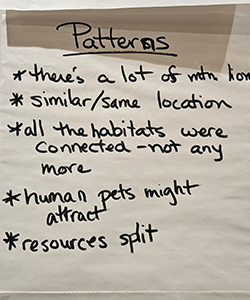
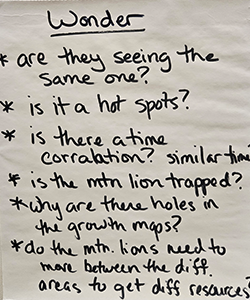
What Changed in the Room
Here's what we noticed during the professional learning session: perspectives shifted. Why? Because the stakes feel real, and their perspectives feel valued.
Participants were eager to share about their own experiences with urban and suburban wildlife encounters and how to incorporate this into their own learning spaces.
One teacher shared how the shifts in the design process pushed their own thinking about how different solutions work for different groups or not. They appreciated that the voices of traditionally marginalized groups were uplifted and included. And even noted that they had never thought about defining the problem from the perspective of the wildlife!
Another teacher commented how the use of the community member role cards gave structure for the conversation and scaffolded participation. As a result, the team collaboration included more voices and perspectives. She was already thinking about how to use this strategy within her own lesson design.
As presenters, we were thrilled because that’s the way of the JEDI! That's critical thinking. That's scientific literacy. That's what happens when we design with justice in mind.
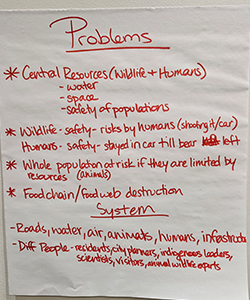
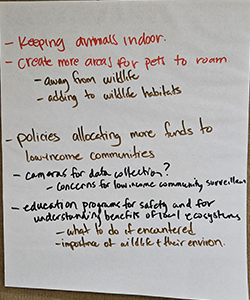
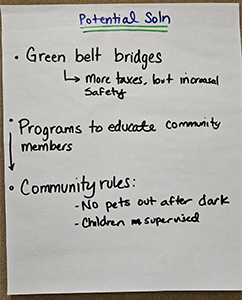
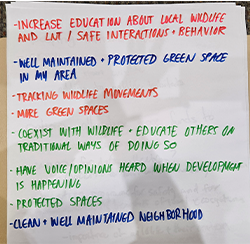
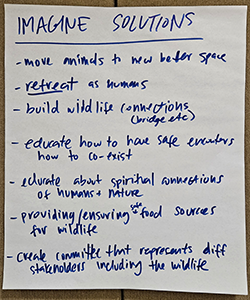
Your Turn: Making Small Shifts
You don't need to overhaul your entire curriculum tomorrow. Start small. Take one existing lab or engineering challenge and ask yourself:
- Justice: Who has power in this scenario? Whose voices are missing?
- Equity: Do all my students have multiple entry points and ways to show what they know?
- Diversity: Have I provided students with opportunities to explore (or consider) how diverse community members approach this problem differently?
- Inclusion: Does this phenomenon connect to my students' lived experiences?
Each small shift can open doors. Maybe your unit on ecosystems includes perspectives from urban farmers. Maybe your water quality lab asks whose neighborhoods have the cleanest water—and why. Maybe your renewable energy project considers which communities bear the environmental costs of both fossil fuels and green technology.
The Takeaway
The engineering design cycle is a powerful tool. But Liberatory Design makes it transformative. When we design for equity, we teach students that science isn't neutral—it's shaped by who gets to ask questions, whose problems get solved, and who benefits from solutions.
And here's the beautiful part: this isn't a distraction from rigorous science. It is rigorous science. Because solving real-world problems requires understanding systems, interested and affected groups, and power dynamics. That's the landscape our students are walking into and how we uplift their agency to design for equity.
So let the JEDI awaken in your classroom. Your students—and their communities—will thank you!
Want to explore more JEDI strategies? Check out our resources at bit.ly/CASE25JEDI
Tags
Save | Print | Email Article

Related Articles


From time to time CASE receives contributions from guest contributors. The opinions and views expressed by these contributors are not necessarily those of CASE. By publishing these articles CASE does not make any endorsements or statements of support of the author or their contribution, either explicit or implicit. All links to outside sources are subject to CASE’s Disclaimer Policy.