

Beyond the Lab: Science & Literature in the Elementary Classroom
By Megan M. Bettis
This spring, I had the pleasure of teaching an elementary science methods course for the first time. Typically, I work with middle and high school credential candidates, so I was a bit nervous as I prepared to teach the class. While I taught elementary science students before, it was always in a self-contained setting, and I wasn’t sure if my strategies and messages would land with the teachers who work with our youngest students.
The credential candidates I taught had a range of experiences teaching science during their student teaching placements. Some had students who went to a science specialist, some taught in classes with no adopted science curriculum, and some just didn't have dedicated science time. And then I came along, telling them to “Start with phenomena!” “Engage in science and engineering practices!” “Create opportunities for scientific discourse!” One student shared, “Science has always been something that was hard for me to understand and that I know very little about,” so I knew incorporating science into their practice might be a tall order for some of these new teachers.
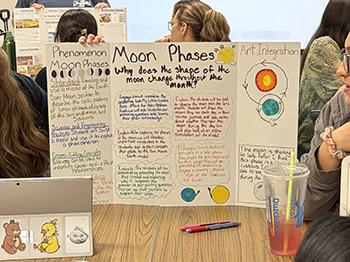
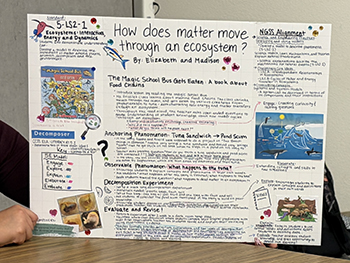
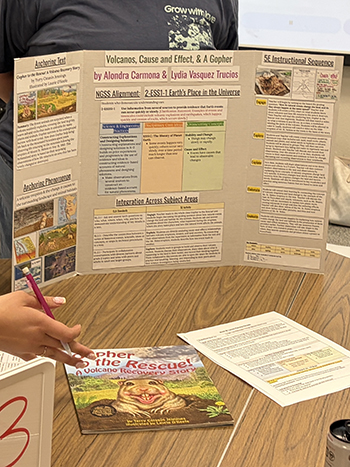
For one assignment, I asked them to design an integrated curriculum unit using an anchoring fiction or non-fiction text, a science-based phenomenon, and the 5E Instructional Model. These new teachers came away with a better sense of the power of science to engage students and spark learning across the subjects! Students reflected on their experience and learning after:
- “My understanding of teaching science has changed because now I understand that science is more than just teaching scientific facts or explaining how/why something works. It is really about helping students notice, wonder, ask questions, and make sense of the world around them.”
- “I…learned how important it is to integrate literacy into science instruction. By using an anchoring text, discussions, and sentence frames, students practice reading, speaking, and writing while also learning scientific ideas.”
I started the course hoping to instill confidence and excitement for teaching science in the elementary classroom. After seeing the lessons they developed and reading their reflections, I’m excited to see how these newly credentialed teachers carry them into their practice. The student who was initially hesitant about science reflected, “This assignment helped me understand that science teaching is not that different from teaching any of the other subjects…science teaching can be fun.” I challenge you to find a way to move beyond the lab and use science as a pathway for reading, writing, and questioning to make sense of the world across subjects.
Tags
Save | Print | Email Article

Related Articles


From time to time CASE receives contributions from guest contributors. The opinions and views expressed by these contributors are not necessarily those of CASE. By publishing these articles CASE does not make any endorsements or statements of support of the author or their contribution, either explicit or implicit. All links to outside sources are subject to CASE’s Disclaimer Policy.