

Learning the Ways of the JEDI: Centering Equity in Lesson Design
By Kristin Majda, Reuben Medlock, Stephanie Chiang with assistance from STEM4Real Coach custom ChatGPT chatbot on behalf of the CASE DEI Committee
Small groups leaned in over clear cups filled with pennies soaking in different solutions. A faint smell of vinegar mixed with excited chatter as students noticed the pennies slowly changing color.
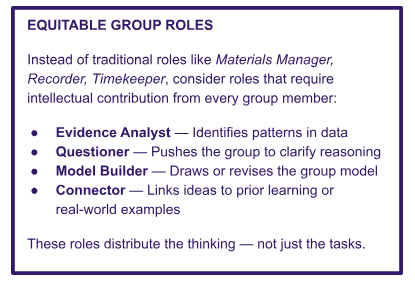
Before the lesson even began, the teacher had already made a series of deliberate choices: sentence stems tied to scientific communication, solution concentrations that would produce visible results quickly, and group roles ensuring every student had a defined intellectual contribution (not just a task to complete). They knew that a traditionally structured lab would likely funnel all the explaining to the most English-fluent student, leaving others to watch. So they designed against that pattern before their students ever walked through the door.
When students gathered around lab tables, the pre-planning results were visible everywhere. One student pointed and said in Spanish, "¡Se está poniendo más brillante!" while another responded in English, "I think the layer of dirt is coming off." Across the room, students moved fluidly between English, Spanish, and Tagalog to describe what they observed: bubbling reactions, color changes, and pieces of the dull coating disappearing from each penny's surface. One student who rarely spoke during discussions filled a full page with labeled diagrams connected to sketches of a rusty gate showing evidence of scientific thinking that a paragraph prompt alone would never have surfaced. The teacher had designed the task from the start to accept multiple forms of scientific communication, not as a support for struggling students, but as a recognition that scientific thinking takes many forms. Access had been built in from the beginning, and the classroom felt alive because of it.
The December issue of Classroom Science, The JEDI Awakens: Designing for Justice in Science Classrooms introduced how integrating principles of Justice, Equity, Diversity, and Inclusion (JEDI) into science instruction transforms traditional engineering design into Liberatory Design — designing with communities, not simply for them. In March, Learning the Ways of the JEDI: Justice in Action dove deeper into the first component — Justice — offering practical strategies for helping students analyze systems, interrogate power, and see science as a tool for civic reasoning.
Now we dive more deeply into the second component: Equity.
Equity is not “sameness”. Equity is proactive design — anticipating barriers before they appear, rather than scrambling to address them after students have already stumbled. In science classrooms, equity lives in the choices we make before a lesson begins: How is the task structured? Who has a way in? What does it look like to succeed here, and have we made that visible to every student?
Equity also means working collaboratively to help students see interdisciplinary connections and lean into their personal, cultural, and community assets as resources for sensemaking. When students can bring what they already know and experience to their science learning, engagement deepens and students are better able to transfer new concepts and skills to other contexts.
Designing for Equity: Planning for Access Before Barriers Appear
Think about the last time a student struggled — not with the science itself, but with getting to the science. Maybe they couldn't read the graph. Maybe group work stalled because one student took over. Maybe the lab assumed a set of background experiences that some students simply didn't have. These are barriers to access and equity asks us to design them out of the experience before they show up.
Equity-centered design asks: If I imagine the full range of my students sitting with this task, does every one of them have an entry point into the learning?
Classroom Examples:
Water Use and Community Decision-Making (Grade 5)
In a 5th grade unit on water use that addresses 5-ESS2-1 (model ways Earth systems interact) and 5-ESS3-1 (research ways communities protect Earth's resources and environment), students investigate how communities conserve water during drought. During math time, they analyze local water usage data, learn how to create line plots, and identify patterns. In science, they bring those same graphs to a new question: What patterns do we notice? What might be causing them? In social studies, they examine how decisions about water access are made in their city. Students then design conservation proposals for their school.
By intentionally aligning math instruction with science investigations, the teacher prevents graphing skills from becoming an access barrier. By integrating civic decision-making, students see that science connects to their own community systems. By designing multiple entry points, whether through discussion, drawing, writing, or problem-solving, every student can find ways to meaningly engage and express their learning.
Proportional Reasoning in Chemistry (High School)
In a high school chemistry unit, math teachers and science teachers co-plan scaffolds for ratio tables and visual models before students encounter concentration calculations in lab investigations. When students arrive at the chemistry lab, the proportional reasoning needed to interpret molarity isn't unfamiliar territory — it's a tool they've already practiced. Equity emerges when we coordinate across disciplines, rather than assuming prerequisite skills are in place.
These aren't isolated examples. They reflect a principle: when we align content across disciplines and design with access in mind from the beginning, we stop asking students to adapt to a system that wasn't built for them and we start building a system for them.
Designing for Equity: Planning Moves
The following strategies can be used to guide equity-centered lesson and unit design. Start with one or two that feel most immediately relevant to your current planning, and build from there.
- Design multiple entry points into complex tasks. Data analysis, modeling, discussion, and visual representation are all legitimate ways to engage with scientific ideas. When a task offers only one pathway of reading this text, completing this lab procedure, analyzing this dataset, we inadvertently sort students by prior knowledge and access rather than by scientific thinking. Ask yourself: In how many different ways can a student engage meaningfully with this phenomenon?
- Offer varied ways for students to demonstrate understanding. Claim-Evidence-Reasoning (CER) writing is powerful, but it is not the only way to show scientific thinking. Annotated models, oral explanations, multimedia presentations, and structured discussions all reveal understanding. Varying modalities also gives students practice in forms of scientific communication they will encounter beyond the classroom.
- Pre-plan scaffolds for academic language — don't wait for students to struggle. Academic language in science is a second language for most students, including those whose home language is English. Introduce new terms in context, not in isolation. Provide visual vocabulary supports, sentence frames that support scientific thinking (not just generic sentence starters), word banks organized by function, and structured talk protocols that give students low-stakes practice with disciplinary language before high-stakes tasks.
- Structure group work so that cognitive authority is shared — not concentrated. The default pattern in collaborative group work often mirrors the inequities we are trying to disrupt: one student does the thinking, one takes notes, one manages materials, and one disengages. Equity requires us to design against this pattern intentionally.
- Audit lab materials and homework expectations for hidden barriers. Cost, technology access, and assumed background knowledge can all function as invisible gatekeepers. A lab that requires materials students must bring from home, a homework assignment that assumes reliable internet access, or a task that assumes familiarity with certain cultural contexts — these can signal to some students that this classroom was not designed with them in mind. A quick audit before launching a unit costs little and can reveal a great deal.
Go Deeper: Resources for Equity-Centered Design
- Universal Design for Learning (UDL) 3.0 Guidelines (CAST) — An evidence-based framework for proactively removing barriers to access, organized around multiple means of engagement, representation, and action and expression.
- OpenSciEd Teacher Tools & Resources — An excellent repository of instructional practices and strategies for scaffolding support in NGSS-aligned classrooms.
Visit the JEDI in Action: Extended Resource Guide for more information and resources. Keep the JEDI Planning Reflection Tool at hand as you plan.
The Courage to Design Differently
Equity work does not require overhauling your entire curriculum. It requires a habit of asking who your lesson was designed for and then making one intentional shift.
When planning your next lesson, take time to reflect on where you have intentionally designed for access. Ask yourself:
- Where am I relying on students to adapt to the curriculum, rather than designing the curriculum to meet them?
- Where might a student quietly disengage — and what barrier might be driving that?
- What is one cross content connection that I could make to remove a prerequisite barrier before it appears?
Every scaffold that prevents a student from hitting an unnecessary wall is an act of equity. Every entry point that opens science to a student who previously had no way in is an act of equity. Every group structure that distributes cognitive authority rather than concentrating it is an act of equity.
Equity in science classrooms is not a detour from rigor. It is what makes rigor possible for everyone.
Remember, the way of the JEDI is one of intentional design – one lesson, one shift, one question, one deliberate choice at a time.
Tags
Save | Print | Email Article

Related Articles


From time to time CASE receives contributions from guest contributors. The opinions and views expressed by these contributors are not necessarily those of CASE. By publishing these articles CASE does not make any endorsements or statements of support of the author or their contribution, either explicit or implicit. All links to outside sources are subject to CASE’s Disclaimer Policy.